Cellfie Lab
Updated: Jan 15
Cellfie Lab, 2023

Exploring cells through a creative and interdisciplinary lab, Cellfie.

Role: Executive Program Director 기획 및 운영 총괄 책임자
Client: Samsung C&T Corporation, 삼성물산
Place: EVERLAND, 애버랜드
Exploring the world of cells through a creative and interdisciplinary cell research laboratory, Cellfie.
Cellfie is a coined term that combines cell and selfie, meaning “a self-portrait of cells.”Cells are the fundamental units of all living organisms, and Cellfie represents the act of observing and capturing images of these cells from various perspectives.
Cellfie Lab offers participants the opportunity to explore plant and animal cells directly. They can observe plant structures and functions, collect and study cells under a microscope, explore 3D cell models using augmented reality (AR) technology, participate in quizzes, and even create delicious cell-shaped cookies.
Through these creative and interdisciplinary activities, participants gain hands-on experience and conduct exploratory research in the field of cell biology.
세포의 세계로 떠나는 생명 탐험, 창의융합 세포 연구실
Cellfie는 "셀"과 "셀카(selfie)"를 합쳐 만든 합성어로, 세포의 자화상을 뜻합니다.
세포는 생물을 이루는가장 기본 단위입니다. Cellfie는 이러한 세포를 다양한 각도에서 관찰하며 촬영하는 사진을 뜻합니다. 셀피랩(Cellfie Lab)은 동식물의 세포를 탐험하면서 참가자들이 직접 세포를 촬영하고 관찰할 수 있는 활동을 제공하는 연구실 활동입니다. 참가자들은 세포의 구조와 기능을 동식물 관찰, 세포 채취및 현미경 관찰, AR 기술 활용 3D모형 탐색과 퀴즈 활동, 달콤한 세포 쿠키 만들기 등 창의융합 활동을 통해 다양하게 체험하고 연구합니다.
Program Overview of Cellfie Lab
I created a program called Cellfie Lab, all about living cells.
The idea actually started with a simple question
what if kids could explore the hidden world of cells while having fun?
In this program, children went on a full learning journey through the park.
Meet professionals from various fields!

You’ll have the chance to meet experts such as zookeepers, veterinarians, plant researchers, botanists, and STEAM educators. They will share stories about animals and plants, the fascinating world of cells, their own experiences as scientists, and special messages of encouragement for young scientists.
1. Exploring living animals and plants

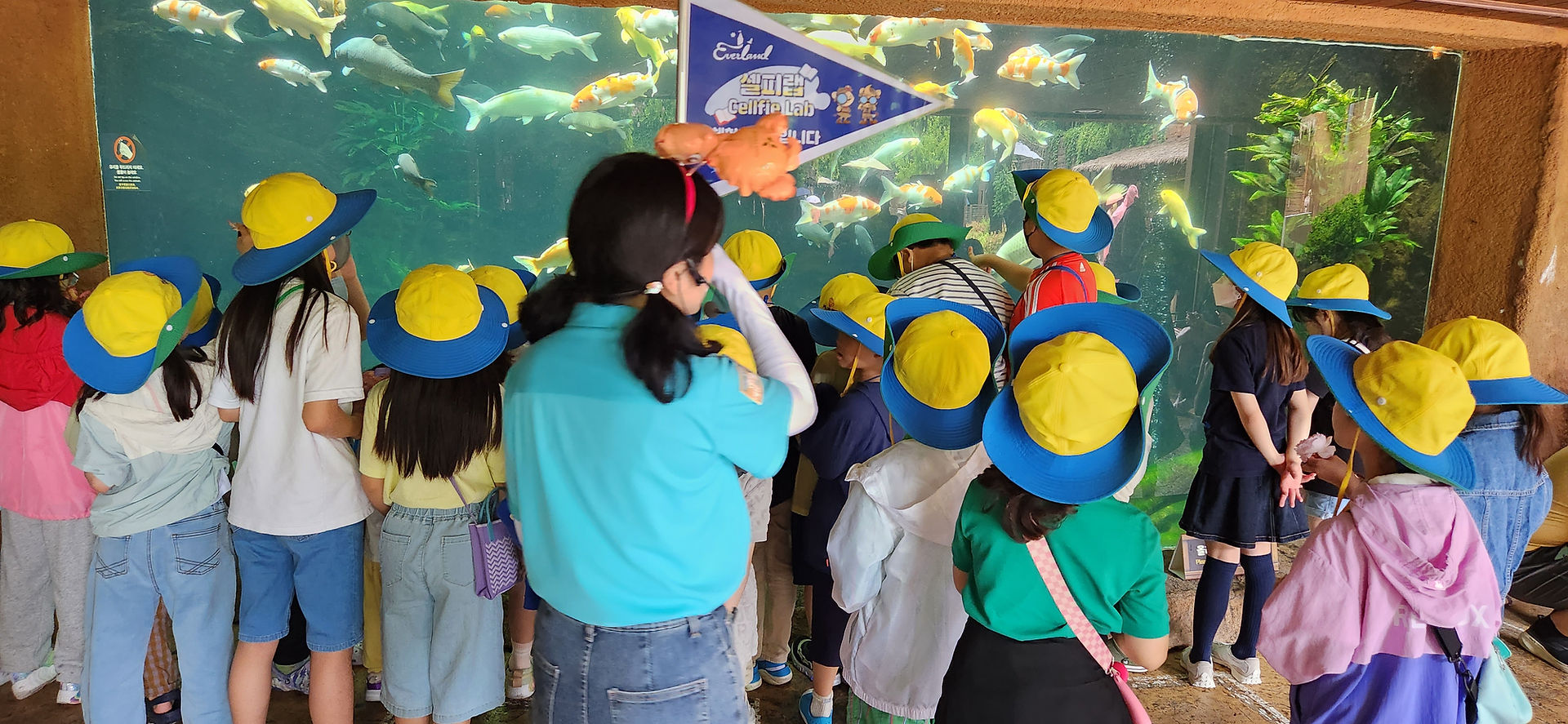
At the zoo, they met zookeepers and listened to their explanations about animals and animal cells. They watched as the zookeeper carefully collected cells from a fennec fox’s mouth, and they received the collected sample. Then, in the botanical garden, they met a plant specialist and listened to explanations about plants and plant cells. They explored different plants and carefully collected tulip that were at the end of their life cycle.
2. Observe cells under an optical microscope

With the collected animal and plant cells, they returned to the lab. Back in the lab, students observed both types of cells under a microscope. They compared the differences between animal and plant cells, identifying structures such as the nucleus and the cell membrane. They also explored how plant cells have cell walls and chloroplasts, which are not found in animal cells.
3. Exploring 3D cells through AR technology


However, there was a limitation because students could only view the cells as flat, two-dimensional images under the microscope. To address this, I introduced AR technology. With AR, students explored three-dimensional models of animal and plant cells, rotating and zooming in to observe each organelle in detail. They also participated in interactive quiz activities to reinforce their learning in a fun and engaging way.
4. Making sweet cell cookies

To conclude the program, students created 3D cookie models of the cells they had observed. These “cell cookies” were made using custom molds that I personally designed. I wanted to provide a hands-on experience where children could create something tangible based on what they learned. By incorporating baking, the activity became enjoyable and memorable. It was one of their favorite moments — students proudly explained their cell models to their parents and then enjoyed eating the cookies together with their families.
5. Meet Various Experts

I conducted interviews and created videos featuring Everland’s zoo veterinarian and the head of the turf research center — professionals that children usually don’t have the chance to meet in person. Through the program, children also met experts from various fields, including zookeepers, plant specialists, and STEAM educators. They listened to stories about animals and plants, learned about cells and the work of scientists, and finally received messages of encouragement dedicated to young scientists as the program came to a close.
Workshop
I participated in every workshop during the program launch, identifying areas for improvement, making revisions, and refining the program.




Educational Material Development
I developed comprehensive educational materials for Cellfie Lab, including student learning kits, teacher guides, lesson plans, and project overviews.